
No products
Product successfully added to your shopping cart
There are 0 items in your cart. There is 1 item in your cart.


FAQ
Tyre Safety
Important Information
Tyres are the only part of your motorcycle that are in contact with the road. Safety in acceleration, braking, steering and cornering all depend on a relatively small area of road contact. It is therefore of paramount importance that tyres should be maintained in good condition at all times, and that, when the time comes to change them, suitable replacements are professionally fitted.
Replacement Tyres
Read the Manual
It is essential that you refer to your motorcycle's manufacturer’s handbook when buying and fitting replacement tires. Changes in tyre size, type and construction should not be made without first seeking advice from the motorcycle manufacturer or tyre manufacturer, since fitting the wrong tyre may have an adverse effect on handling, safety and wear.
Motorcycle tyres are only for use on vehicles for which motorcycle tyres were originally specified by the manufacturer & any other use may be dangerous.
Motorcycle tyres which have been subject to use on Dyno's must no longer be used for subsequent, normal service. Use of motorcycle tyres on a Dyno may invalidate the tyre warranty. All tests on Dyno's must be carried out with test tyres, special tyres reserved for maintenance purposes, or tyres which are worn out or downgraded.
What do the numbers mean?
LOAD INDEX & SPEED RATINGS
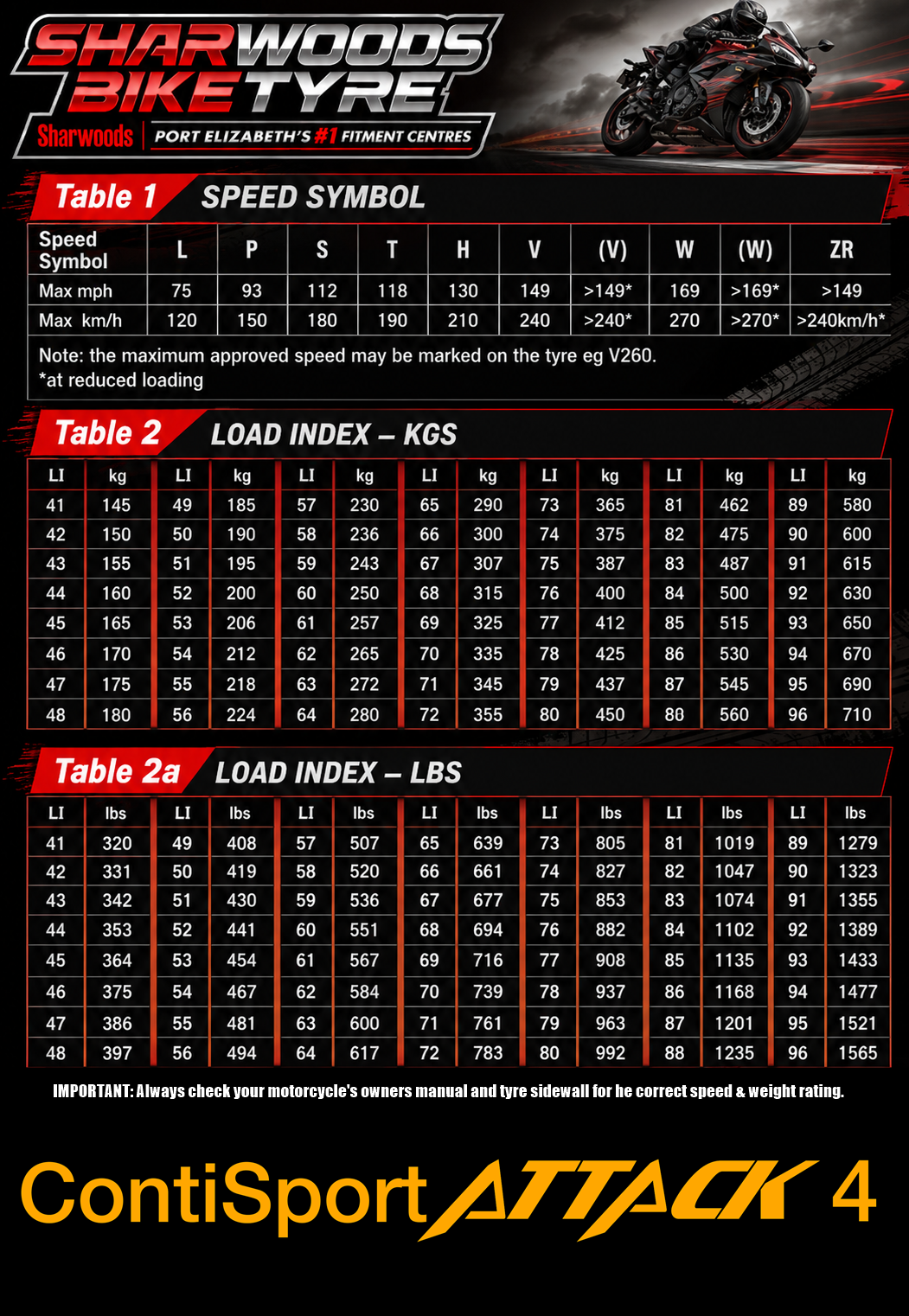
Speed Symbol
The SPEED SYMBOL indicates the maximum speed at which the tyre can carry a load corresponding to its Load Index under service conditions specified by a tyre manufacturer.
These speeds are shown in Table 1 and apply to tyres when in good condition, inflated to the correct pressure, operating within their specific load capacity and fitted to the correct size rim. Speeds quoted are the maximum speed of which the tyre is capable, not the speed at which it is normally ridden. V, W and Z rated tyres may also be used at higher speeds but at reduced loadings. For guidance only Table 3 can be used to calculate loads at specific speeds on V, W and Z tyres.
ALL MAXIMUM SPEEDS REFERRED TO ARE SUBJECT TO APPLICABLE LEGAL SPEEDS.
Load Index
The LOAD INDEX is a numerical code associated with the maximum load a tyre can carry (except for loads at speeds above 130 mph (210 km/h) – see Table 2/2a) at the speed indicated by its Speed Symbol under service conditions specified by manufacturer. You should only fit replacement tyres bearing the precise speed and load index referred to in the motorcycle manufacturer’s handbook. Before you make any variation please consult the manufacturer to ensure that the replacement tyre is a correct fitment for your motorcycle.

WIDTH (190)
This number indicates the tyre’s section nominal width, measured in millimeters from sidewall to sidewall. In this case 190mm. Note: the actual physical width of the tyre on the rim can differ from the nominal width.
ASPECT RATIO (50)
This number indicates the tyre’s aspect ratio or height expressed as a percentage of its width. In this case the aspect ratio is 50% of the 190mm width, making it 95mm.
WHEEL DIAMETER (ZR17 M/C)
On a sports bike tyre these letters are usually “ZR”. The “Z” indicates the speed rating of the tyre, which in this case means it is rated above 240kph/149mph. The “R” denotes that the tyre is of radial type construction. The “17″ denotes that the tyre is 17 inches in diameter whilst “M/C” means the tyre is for a motorcycle.
LOAD INDEX & SPEED RATING (73W)
The ‘73W’ indicates the load and speed indexes of the tyre and should always be looked at together when you buy a new tyre. In this case the ’58’ denotes that the tyre is rated for a maximum carrying weight of 236kg at maximum pressure. The “W” represents the maximum speed for the tyre when it is correctly inflated and being used under load, in this case 270km/h. Please remember however that when buying new tyres that you match the speed rating with the speed capabilities of your motorcycle, if exceeded, this risks tyre failure, hence you should always replace a tyre with one of at least the same speed rating so that you don’t reduce the speed capability of your bike.
Please refer to the load index and speed rating tables for more information.
How important is maintaining the correct tyre pressure?
Tyre pressure is one of the most important maintenance tasks you should perform before every ride. Although the carcass and overall structure of the tyre has a significant effect on the overall performance of the tyre, for it to function properly you must have sufficient air pressure in the tyre.
We recommend that you check your air pressure before every ride, especially when carrying a load. Every 4 psi of air lost in the tyre translates to approximately 60 to 70 pounds reduction in load carrying capacity. For example, if your tyre pressure is 34 psi, instead of a recommended 41 psi, you would need to take 120 to 140 pounds of load off of the motorcycle. Never exceed the maximum load capacity that is indicated on the sidewall of the tyre at the recommended air pressure.
Another reason proper air pressure is so important, is to ensure proper handling of the motorcycle. Never over-inflate a tyre, as over-inflation of a tyre may reduce the contact patch. Likewise, under-inflation generates uneven contact pressure and support. Both conditions negatively affect the handling and stability of the motorcycle.
Can i fit a wider tyre?
Wider tyres should only be installed with the approval of the motorcycle or tyre manufacturer. If wider tyres are approved for a particular motorcycle, one size designation is the typical permissible size increase. Be sure to consider clearance for width and diameter, the effect on stability and handling, and whether your rim is wide enough. Always allow for some tyre growth, as all tyres will increase in size after they have been inflated and ridden on for a few hundred km's.
Tube Type (TT) or Tubeliss (TL) ?
There are two different types of Continental Motorcycle and Scooter Tires available: Tube-Type Tires and Tubeless-Tires.
Tubeless-Tires (TL Tires)
These tires are designed to be mounted on tubeless rims (see rim description below) and have a corresponding TL marking in the description of the tire size (e.g. 120/70 ZR 17 M/C 58W TL).
Continental Tubeless-Tires can be mounted on tubeless rims without inner tubes but also on tube-type rims, if mounted with inner tubes of the correct size.
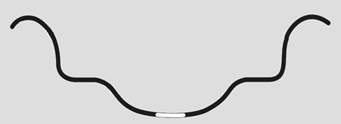
Tubeless rim
- only to be used without tube
- e.g. MT H2-type with safety humps
- usually used for cast wheels

Tube-Type Tires (TT Tires)
TT tires are designed to be mounted on tube-type rims only (see rim description below) and have a corresponding TT marking in the description of the tire size (e.g. 90/90-21 M/C 54S TT).
Tube-Type Tires from Continental have to be mounted on tube-type rims with inner tubes of the correct size but are not allowed to be mounted on tubeless rims, neither with tubes nor without tubes.
Tube-type rim
- only to be used with tubes
- e.g. WM-type
- usually used for spoked wheels
Inner Tubes
- If replacing a tire with inner tube, always use a new tube!
- It is not allowed to mount tubes on tubeless rims, only tube type rims are suitable for tubes!
- Continental tubes are developed for speeds up to 210 km/h (130 MPH).
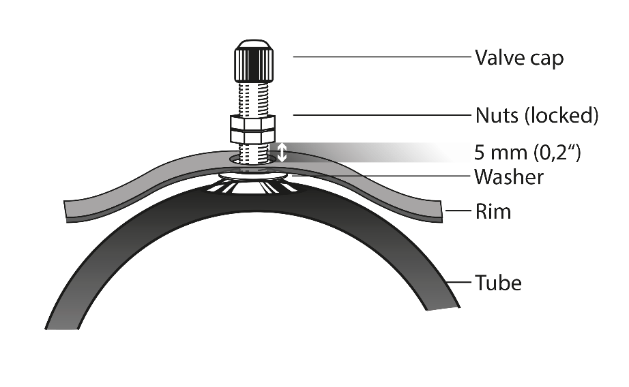
- Before mounting the tube, place the washer on the valve stem.
- After mounting lock both nuts against each other with a space of approx. 5mm (0,2”) above the rim. This type of mounting ensures, that on the one hand the valve is held in position for inflation, but on the other hand it does not tear off the tube in case the tire and tube rotate slightly on the rim.
Valve Caps
- Please mount the valve cap after mounting a tire!
- The valve cap protects the valve core from dirt and avoids air loss in case of high speeds or a faulty valve core.
- Your valve core may open with centrifugal force – a loss of pressure could occur.
- Use a quality valve cap with O-ring.
Flaps (Rim Strips)
- Flaps or rim strips are used for tube-type rims.
- They are in place to protect the inner tube from damage, especially from the nipples of the spokes, which are mounted inside the rim.
- When fitting a new tire or inner tube, the flap must be checked for damage and replaced if necessary.
Do new motorcycle tyres need to be "broken in" ?
It is important is to scuff up the tread to develop traction (especially for tires without our TractionSkin technology). New tires have a smooth, slippery surface that must first be roughened by moderate use. Maximum grip can only be ensured after the surface structure has been broken-in so the tire can interlock with the rough surface of the road.
Even though Continental's TractionSkin technology contributes to greater safety on the first ride, it is necessary for the rider to condition the tires for the demands of high-power motorcycles by loading them moderately and evenly during the break-in period, thus preventing tire damage. It is easy to damage a modern high-performance sport/touring tire by mounting it and then immediately subjecting it to severe stress (especially high-speed riding). Breaking in ensures that the tread compound will not be damaged by destroying the cross-linking of the high-tech polymers that generates our outstanding grip performance.
During the break-in period (approximately 150 km / 100 miles), heavy acceleration and braking, extreme lean angles and especially high-speed riding must be avoided. We recommend riding a twisty road and to start gently with low speed and lean angle and then slowly increase speed and acceleration until you develop a dull/rough finish across the usable tread surface.
Remove the tire labels before riding.
Always warm up your tires for every ride by gently braking, accelerating and cornering for the first few miles.